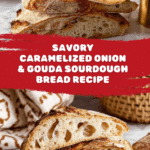
Caramelized Onion And Gouda Sourdough Bread Recipe

This Caramelized Onion and Gouda Sourdough Bread is a savory artisanal loaf combining the rich sweetness of slow-cooked onions with the creamy, smoky flavor of shredded Gouda cheese. Made using a traditional sourdough starter, this bread offers a rustic crust and an indulgently cheesy, flavorful crumb, perfect for sandwiches or enjoying on its own.
- Prep Time: 30 minutes (active) plus 4-5 hours total including resting and bulk fermentation
- Cook Time: 40-45 minutes
- Total Time: Approximately 5 to 6 hours plus up to 3 days cold retardation
- Yield: 1 large loaf (about 1.2 kg) 1x
- Category: Bread
- Method: Baking
- Cuisine: European
- Diet: Vegetarian
Ingredients
Scale
Dough Ingredients
- 350 g water (room temperature)
- 100 g sourdough starter (active)
- 500 g bread flour (unbleached)
- 12 g coarse sea salt
Fillings
- 1 yellow onion (medium-large)
- 2 tablespoons unsalted butter
- 80 g shredded Gouda cheese
Instructions
- Make The Dough: In a large bowl, whisk together 350 g of room temperature water and 100 g of active sourdough starter until mostly combined. Add 500 g bread flour on top and sprinkle 12 g coarse sea salt evenly over the flour. Using a Danish dough whisk, spatula, or spoon, mix until a loose, shaggy dough forms. Knead the dough gently by hand until all dry flour bits are fully incorporated. Cover the bowl and let it rest for 60 minutes.
- Stretch And Fold: With damp hands, reach under the dough, stretch a flap until long enough to fold over itself, then fold it. Rotate the bowl 90 degrees and repeat three more times, completing one set of stretch and folds. Cover and rest the dough for 60 minutes. Repeat this stretch-and-fold process one more time, followed by another 60-minute rest.
- Caramelize Onions: Slice the onion thinly and place in a heavy skillet with 2 tablespoons of unsalted butter. Cook over medium-low heat, stirring frequently, until the onions turn a deep golden brown, caramelize fully, and release a fragrant aroma. Allow to cool in the refrigerator until use.
- Laminate and Bulk Ferment: Lightly flour your work surface and gently turn out the dough. Press and stretch into a rectangle, resting briefly if the dough resists tearing. Spread about half of the caramelized onions evenly over the top two-thirds of the dough, then distribute half of the shredded Gouda on top. Fold the bottom third of the dough upward, then spread half of the remaining onions and cheese over the folded section. Fold in the bottom right and left corners, sealing the dough. Spread remaining onions and cheese on the exposed dough before folding it down to form a neat package. Using a bench scraper, transfer the dough to a large bowl, cover, and bulk ferment for 2 hours.
- Pre-Shape and Shape: After bulk fermentation, check that the dough has risen and shows bubbles and a smooth surface. Transfer the dough onto a lightly floured surface and stretch into a large rectangle. Fold the bottom third up like a letter, then fold right and left sides one third each towards the center. Roll the dough from the bottom fold upward to form a log. Cover with a clean towel and rest for 30 minutes. Uncover, flip dough over, clasp the ends towards the center, and press to create a batard shape. Dust with rice flour and place seam side up into a banneton.
- Prove and Cold Retard: Allow the dough to prove in the banneton for 2 to 3 hours at room temperature until slightly puffy. Then cover and refrigerate to cold retard for up to 3 days, enhancing flavor development. Baking immediately after proving is possible but less flavorful.
- Bake: Preheat your oven to 450°F (232°C) with a Dutch oven, cloche, or baking vessel inside. Once fully heated, invert the banneton dough onto parchment paper. Score the dough with a lame or sharp knife. Carefully lift the dough using the parchment and place it inside the preheated Dutch oven. Cover and bake for 30 minutes, then uncover and bake for an additional 10-15 minutes until the crust is deeply browned and the internal temperature reaches between 205-210°F (96-99°C).
- Cool: Remove the baked bread from the Dutch oven and transfer to a wire rack. Let the bread cool completely for at least 2 hours before slicing to preserve crumb texture and avoid gummy slices.
Notes
- Using room temperature water helps maintain an active fermentation process for the sourdough.
- Patience during caramelizing onions is key to develop rich sweetness and deep flavor; cook low and slow.
- Cold retardation in the fridge enhances flavor complexity and dough strength.
- Allow the bread to cool fully before slicing to ensure the best crumb texture.
- A sharp lame or razor blade is ideal for scoring to allow the dough to expand properly during baking.
Keywords: sourdough bread, caramelized onion bread, gouda cheese bread, artisanal bread, savory sourdough, cheese bread, homemade sourdough